Here's what makes it click so quickly once you actually start cooking it, and where to begin if you're curious.
A Quick Overview of the Cuisine
Georgian food sits at a flavorful crossroads between Eastern European, Middle Eastern, and Central Asian cooking traditions, shaped by the country's location along historic trade routes between Europe and Asia. The result is a cuisine built around walnuts, fresh herbs, tangy fermented and pickled flavors, and warm spice blends, balanced with comforting bread and cheese dishes that feel instantly familiar even on a first try.
What makes it approachable rather than intimidating is that most signature dishes rely on a small set of repeatable building blocks. Once you understand how Georgian cooks use walnuts as a thickener, cilantro and dill as a flavor backbone, and a few key spice combinations, you start to see the same logic show up across very different-looking dishes, which makes the cuisine feel a lot more learnable than it first appears.
Key Ingredients Worth Knowing
Walnuts are arguably the most defining ingredient in Georgian cooking, ground into sauces and pastes that add richness and body without needing cream or excessive amounts of oil. This single ingredient does a lot of heavy lifting across the cuisine, showing up in everything from vegetable dishes to sauces for meat and poultry.
Khmeli suneli, a Georgian spice blend typically including coriander, fenugreek, dill, marjoram, and dried marigold petals, brings a warm, slightly tangy depth to soups, stews, and bean dishes. It's increasingly available at specialty grocers or online, though a reasonable substitute can be approximated with ground coriander, a small amount of dried fenugreek, and dried dill if you can't find the real blend locally.
Fresh herbs, especially cilantro, dill, and parsley, are used generously rather than as a garnish afterthought, often blended directly into sauces or piled into dishes in real volume. If you're used to herbs playing a supporting role in other cuisines, Georgian cooking treats them more like a core ingredient.
Sulguni cheese, a semi-soft, slightly salty, stretchy cheese, is central to Georgian baked goods and can usually be substituted with a combination of mozzarella and feta if you can't find it locally, which gets you reasonably close to the texture and flavor profile.
Pomegranate molasses and tkemali (a tart plum sauce) bring the sour, tangy notes that balance out the richness in many Georgian dishes, playing a similar role to how a squeeze of lemon might function in other cuisines, but with more complexity and depth.
Popular Dishes to Know
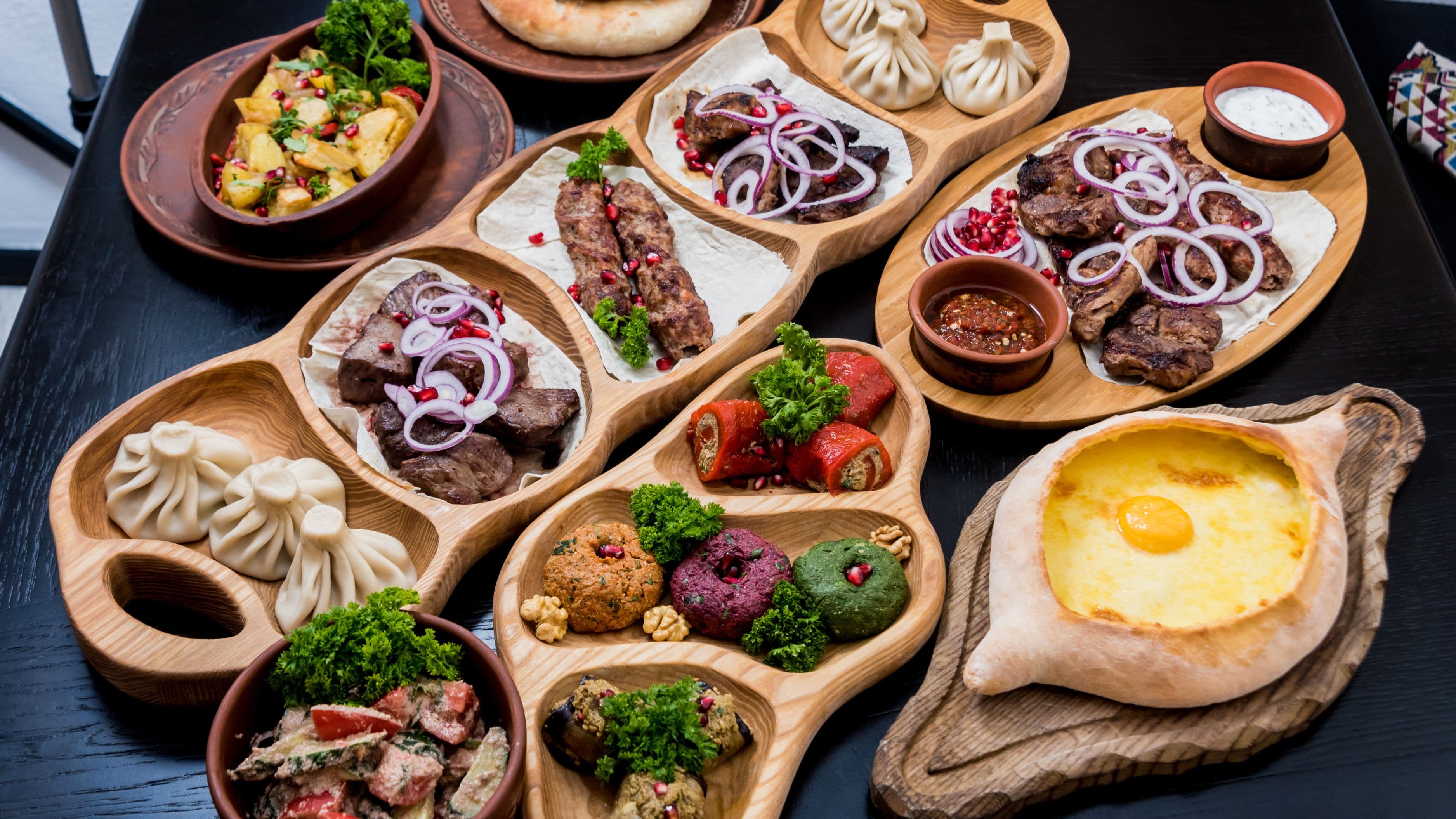
Khachapuri is Georgia's most internationally recognized dish, a cheese-filled bread that comes in several regional variations, the most famous being the boat-shaped Adjarian khachapuri topped with a raw egg and butter that gets stirred into the molten cheese tableside. It looks impressive but is fundamentally a simple yeasted dough filled with cheese, which is exactly why it translates so well to a home kitchen.
Khinkali are large, twisted dumplings filled with seasoned meat and a flavorful broth that forms naturally as the filling cooks, traditionally eaten by hand, holding the dumpling by its thick dough "topknot" and biting in carefully to avoid losing the broth inside. The technique takes a bit of practice to shape, but the filling itself is straightforward, just seasoned ground meat, onion, and a few spices.
Lobio is a hearty bean stew, often flavored with walnuts, herbs, and warm spices, that showcases how Georgian cooking turns humble, affordable ingredients into something deeply flavorful without requiring expensive cuts of meat or hard-to-find ingredients.
Pkhali refers to a category of vegetable dishes, often spinach, beets, or eggplant, blended with walnuts, garlic, and herbs into a thick, flavorful spread, typically served as part of a spread of small dishes rather than a single main course.
How to Start Cooking Georgian Food at Home
Begin with khachapuri, since it's genuinely one of the more forgiving entry points into the cuisine despite looking like an ambitious project. A simple yeasted dough, a cheese filling using widely available mozzarella and feta as a sulguni substitute, and a hot oven get you most of the way to an authentic result without needing specialty ingredients or advanced technique.
From there, lobio is a natural next step, since it's essentially a flavorful bean stew that uses pantry staples (canned or dried beans, onion, garlic) plus a handful of fresh herbs and walnuts to build complexity. It's a low-pressure dish to practice the walnut-and-herb flavor base that shows up across so much of Georgian cooking, without the added challenge of dough or dumpling shaping.
Once you're comfortable with those building blocks, khinkali is worth attempting, ideally on a day when you have a bit more time to practice the pleating technique. The filling itself is simple enough that the learning curve is really about the dough-shaping mechanics rather than the flavors, which you've likely already gotten comfortable with through the earlier dishes.
Tips for Best Results
Don't skip the resting time on doughs for khachapuri or khinkali, since a properly rested dough is noticeably easier to work with and produces a better final texture than one rushed through the process. When using ground walnuts in sauces or pkhali, toast them lightly first if your recipe doesn't already call for it, since this brings out a deeper flavor that raw walnuts don't fully deliver.
If you can't find khmeli suneli or sulguni cheese locally, don't let that stop you from trying these dishes. The suggested substitutes get you close enough to the authentic flavor and texture for a satisfying home version, and you can always source the real ingredients online later if you want to refine your results further.
What to Avoid
Avoid overfilling khinkali dumplings, since this makes them difficult to seal properly and increases the chance of the broth leaking out during cooking rather than staying contained inside. Don't rush the cheese filling for khachapuri by using only one type of cheese if you're substituting for sulguni, since a blend (typically mozzarella for stretch and feta for tang) gets you a much closer result than either cheese alone.
It's also worth resisting the temptation to skip fresh herbs in favor of dried substitutes wherever possible, since the volume and freshness of herbs used in Georgian cooking is part of what gives the cuisine its distinct character, and dried versions don't deliver the same brightness.
FAQ
Is Georgian food spicy? Not typically in the way chili-based cuisines are spicy – Georgian cooking relies more on warm spice blends, tangy and sour flavors, and herb-forward freshness rather than heat, making it approachable for those sensitive to spicy food.
What's a good first Georgian dish to cook if I'm short on time? Lobio is one of the quickest entry points, since it comes together with pantry staples and doesn't require any specialized dough work, typically ready in under an hour.
Can I make khachapuri without sulguni cheese? Yes – a combination of mozzarella for stretch and feta for tang is a widely used and effective substitute that gets you close to the authentic flavor and texture.
Where can I find specialty Georgian ingredients like khmeli suneli? Specialty international grocers, Eastern European markets, and online retailers typically carry it, though the suggested substitute blend works well if you don't have access to the real thing locally.
Georgian cuisine rewards curiosity more than it demands expertise. Once you get comfortable with a handful of core ingredients and techniques, dishes that look impressively complex on a restaurant menu start to feel genuinely achievable in your own kitchen.
📚 Sources
Smithsonian Magazine – The Rich History and Flavors of Georgian Cuisine - https://www.smithsonianmag.com/travel/georgia-food-180970934/
NPR – Georgian Cuisine and Its Influences - https://www.npr.org/sections/thesalt/2017/05/03/526558320/the-cuisine-of-georgia-is-having-a-moment