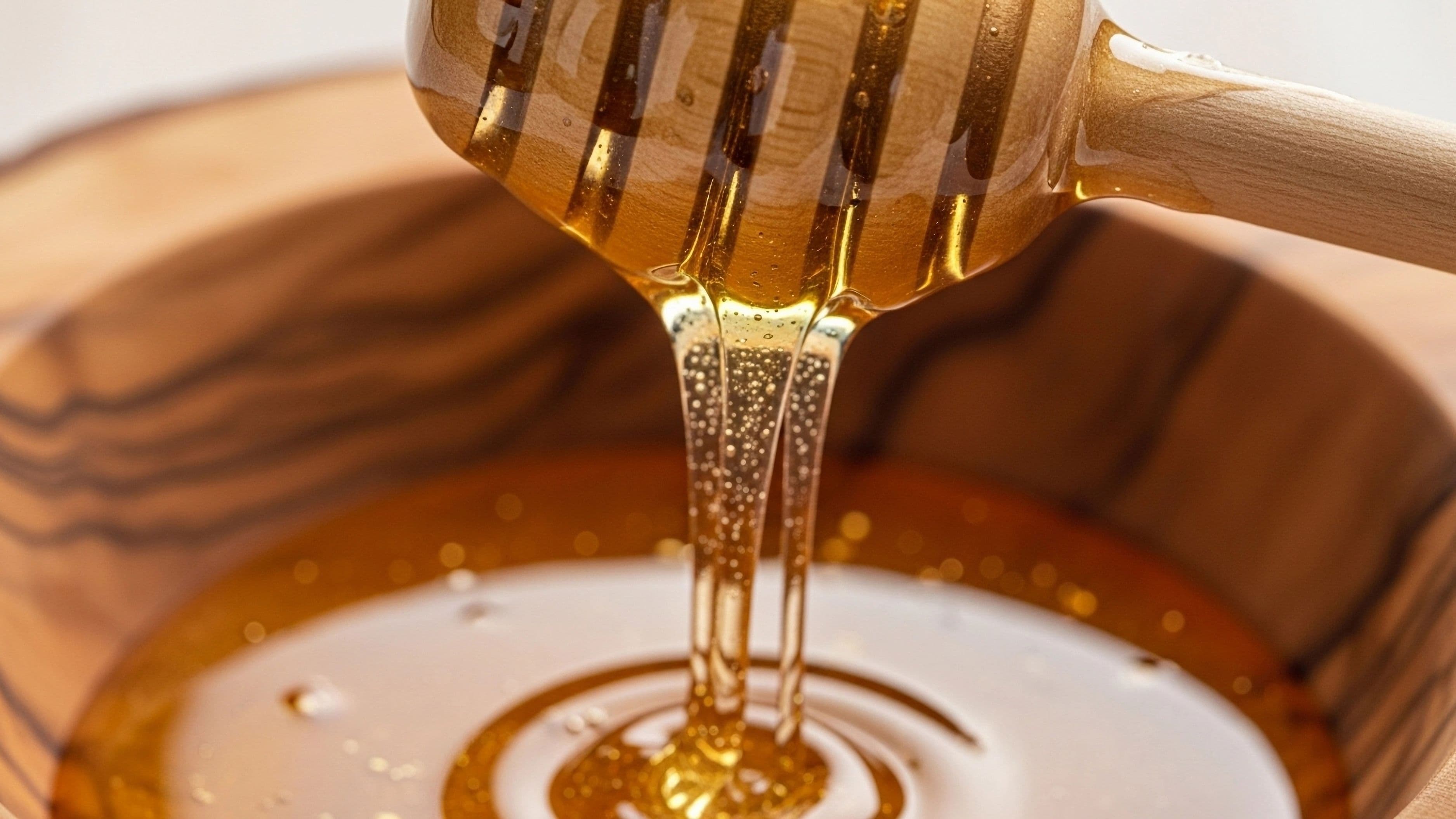
The good news is that once you understand the rules, the swap is genuinely useful – and in many recipes, the result is better than the original.
How Honey and Sugar Are Different
Sugar – specifically granulated white sugar – is almost pure sucrose. It's a dry, crystalline ingredient that dissolves in liquid, melts under heat, and provides sweetness without contributing moisture, fat, or any significant flavor of its own.
Honey is a liquid that is roughly 80% sugars (primarily fructose and glucose) and about 17–20% water, with the remainder made up of trace minerals, enzymes, and the aromatic compounds that give different honeys their distinct flavor. Fructose is sweeter than sucrose, which is why honey tastes noticeably sweeter than sugar by volume even though the caloric difference is modest.
That water content is the biggest practical difference in cooking. Every tablespoon of honey brings roughly a teaspoon of water into your recipe. In a sauce or dressing, that's usually fine. In baking, where the balance of wet and dry ingredients determines texture and structure, it changes everything.
The Standard Substitution Ratio
The widely accepted starting point is to use three-quarters cup of honey for every one cup of sugar a recipe calls for. This accounts for honey's greater sweetness – you don't need as much to hit the same level of sweet.
Because you're also adding liquid, you need to remove some from elsewhere in the recipe to compensate. The rule of thumb is to reduce other liquids (milk, water, juice) by about three tablespoons for every cup of honey you use. If the recipe has no liquid to reduce – a dry rub, for example – you'll need to add a small amount of extra dry ingredient like flour to absorb the moisture.
There's also the acidity factor. Honey is mildly acidic, with a pH between 3.4 and 6.1 depending on the variety. In baked goods that use baking soda as a leavener, that acidity can react with the soda and affect how much the item rises. To keep leavening balanced, add a pinch of baking soda (about one-quarter teaspoon per cup of honey) to neutralize the acid.
So, in summary, for every cup of sugar you're replacing with honey:
Use three-quarters cup of honey
Reduce other liquids by three tablespoons
Add one-quarter teaspoon of baking soda if the recipe uses baking soda as the primary leavener
What Happens in Baked Goods
Baking is where the substitution has the most visible impact – some of it welcome, some requiring adjustment.
Moisture and texture: Honey is hygroscopic, meaning it attracts and holds water molecules from the surrounding environment. In practical terms, this means baked goods made with honey tend to stay moister and fresher longer than those made with sugar. Honey banana bread, honey muffins, and honey cakes have a noticeably soft, tender texture even a day or two after baking. If you've ever had a cookie go stale fast, swapping in honey is one legitimate fix.
Color and browning: Honey causes baked goods to brown faster and more deeply than sugar because fructose caramelizes at a lower temperature than sucrose. This is where most people run into trouble – the outside of a cake or a loaf of bread looks dark and done while the inside is still underbaked. The fix is to lower your oven temperature by 25°F (about 15°C) when baking with honey instead of sugar. This slows the surface browning and gives the interior time to catch up.
Rise and structure: The substitution can affect how much lift your baked good gets, particularly in cakes and quick breads. The added moisture makes the batter slightly looser, and the acidity interacts with leaveners. Following the baking soda adjustment above helps stabilize this. Dense, moist baked goods – banana bread, carrot cake, gingerbread, brownies – handle the swap better than very light, delicate cakes that depend on precise dry-to-wet ratios for their crumb structure.
Flavor: This one is entirely positive. Honey adds a warm, floral note that sugar simply doesn't have. In spiced baked goods – anything with cinnamon, ginger, cardamom, or cloves – honey and the warm spices reinforce each other in a way that sugar doesn't. In a plain vanilla cake, the honey flavor is more prominent and may or may not be what you want. A mild honey like clover is more neutral; a stronger honey like buckwheat will make its presence known.
What Happens in Cooking (Not Baking)
Outside of baking, the substitution is more forgiving and often more straightforward.
Sauces and glazes: Honey dissolves into sauces easily and adds both sweetness and body. Its natural thickness means that honey-based sauces and glazes tend to be slightly more viscous and cling to food better than sugar-based equivalents. In a pan sauce, stir honey in off the heat or at low heat – it can scorch if exposed to high heat for too long because of its fructose content.
Salad dressings: Honey is excellent in vinaigrettes. It adds sweetness, rounds out the acid, and also acts as an emulsifier – the proteins in honey help oil and vinegar stay blended longer than a straight sugar-sweetened dressing would. A small amount (half a teaspoon to a teaspoon) in a standard vinaigrette is enough to make a noticeable difference in both flavor and texture.
Marinades: Honey in a marinade contributes sweetness that caramelizes beautifully on grilled or roasted meat. The same browning tendency that requires a lower oven temperature in baking works in your favor here – you get a gorgeous lacquered crust on chicken, pork, or salmon. Just watch the heat carefully, since honey-heavy marinades can go from caramelized to burnt quickly over direct flame.
Hot drinks and beverages: Honey dissolves more easily in warm liquids than cold ones. In tea or warm water, it works perfectly as a direct sugar replacement. In cold drinks, it can clump and sink to the bottom. If you want to sweeten a cold drink with honey, dissolve it first in a small amount of warm water to make a honey syrup that integrates smoothly.
Which Honey Works Best
Not all honey behaves or tastes the same, and the variety matters for different applications.
A mild, neutral honey like clover honey is the most versatile choice for substitution. It contributes sweetness and moisture without a strong floral character that might clash with the dish. It's also the most widely available and least expensive option.
Wildflower honey has more complexity and a slightly more pronounced flavor – good in dressings, marinades, and baked goods where a nuanced background note is welcome.
Buckwheat honey is dark, bold, and distinctly flavored – more like molasses than floral honey. It's excellent in heartier recipes like whole grain breads, gingerbread, and spice cakes, but it will dominate in delicate applications.
Manuka honey is prized for its antimicrobial properties but has a strong, distinctive flavor that doesn't disappear in cooking. It's also significantly more expensive, which makes using it as a sugar substitute impractical for most cooking purposes.
Where the Substitution Works Best
Some recipes genuinely improve with honey instead of sugar. Others are better left as written.
Honey substitution works particularly well in: quick breads and muffins, granola and energy bars, oatmeal, yogurt parfaits, salad dressings and marinades, glazes for roasted meats and vegetables, spiced cakes and cookies, and warm drinks. These are recipes where the added moisture is manageable, the honey flavor complements the other ingredients, and the browning tendency can be accounted for.
The substitution is more challenging in: delicate layer cakes and sponge cakes (where precise structure is critical), shortbread and other cookies that rely on the crystalline structure of sugar for their texture, any recipe where the color of the finished dish matters and deep browning would be a problem, and meringues or royal icing where sugar's dry, crystalline nature is structurally essential.
Common Mistakes to Avoid
Using too much honey is the most frequent error. Because it's sweeter than sugar by volume, using a 1:1 ratio makes the dish noticeably sweeter than intended and significantly increases the moisture in baked goods. Always scale down to three-quarters.
Forgetting to lower the oven temperature when baking causes premature browning that makes baked goods look done when they're not. Set the oven 25°F lower than the recipe calls for as a baseline whenever you substitute honey.
Adding honey to very hot liquids or high-heat pans without attention causes it to scorch quickly. Honey added to a pan over medium-high heat needs to be watched and stirred; over high heat, it can burn in seconds.
Storing honey incorrectly affects its quality over time. Honey stored in a warm, humid environment can ferment or crystallize unevenly. Keep it in a tightly sealed jar at room temperature, away from direct heat and sunlight. If it crystallizes, warm the jar gently in a bowl of hot water to return it to a liquid state – it's perfectly fine to use.
FAQ
Does honey work in every baking recipe as a sugar substitute? Not quite every recipe. It works well in most moist baked goods – quick breads, muffins, dense cakes, cookies with a soft or chewy texture. It's less reliable in recipes that depend on sugar's crystalline structure for their texture, like shortbread, certain layer cakes, or anything where you cream butter and sugar together for a long time (the aeration from that process works differently with liquid sweeteners).
Will the honey flavor come through in the finished dish? It depends on how much you use and how strong the honey is. In a recipe with bold flavors – cinnamon, ginger, chocolate, lemon – the honey background tends to be subtle. In a plain cake or a simple syrup, you'll notice it more. Using a mild clover honey minimizes the honey character if you want a neutral result.
Is baking with honey healthier than baking with sugar? The caloric difference is modest – honey has roughly 64 calories per tablespoon versus 48 for sugar, though you use less of it by volume. Honey does contain small amounts of antioxidants and trace minerals that refined sugar doesn't, but the quantities in a typical recipe are too small to have a meaningful health impact. The practical advantage is more about flavor and texture than significant nutritional difference.
Can I use honey to substitute for brown sugar? Yes, with similar adjustments. Brown sugar has a molasses note that honey can partially replicate – particularly a darker honey like wildflower or buckwheat. Use the same three-quarters cup honey per cup of brown sugar ratio, reduce liquids, and lower your oven temperature. The result won't be identical to brown sugar but will have a similarly warm, complex sweetness.
Why did my honey baked goods turn out too dense? The most common causes are using too much honey (stick to three-quarters cup per cup of sugar), not reducing the liquid in the recipe sufficiently, or not making the baking soda adjustment when the recipe uses baking soda. Overmixing the batter after adding honey can also develop excess gluten, leading to a denser texture. Mix until just combined once wet and dry ingredients meet.
📚 Sources
Serious Eats – The Science of Honey in Baking: https://www.seriouseats.com/honey-baking-substitution-tips
America's Test Kitchen – Substituting Honey for Sugar: https://www.americastestkitchen.com/articles/3839-can-i-substitute-honey-for-sugar
National Honey Board – Honey in Cooking and Baking: https://www.honey.com/honey-industry/honey-as-an-ingredient/cooking-and-baking
King Arthur Baking – How to Substitute Honey for Sugar: https://www.kingarthurbaking.com/learn/guides/substitutions