What Scoring Actually Does to Your Dough
Scoring means making shallow, deliberate cuts into the surface of your dough right before it goes into the oven. During baking, dough continues to expand rapidly in the first several minutes from trapped gas and steam, a phase bakers call "oven spring." That expansion has to release somewhere, and a clean, intentional score gives it a controlled path to do exactly that, rather than letting the loaf tear randomly along whatever weak point in the crust gives way first.
Beyond the practical function, scoring is also where a lot of visual character comes from in artisan-style bread – the classic diagonal slashes on a baguette, or a decorative wheat-stalk pattern on a boule, are both functional and aesthetic at the same time.
When to Score: Timing Matters More Than People Realize
Scoring should happen immediately before the dough goes into the oven, not earlier. If you score too far in advance, the cuts can dry out or the dough can relax and lose the definition of the cut, resulting in a less clean expansion during baking. Doing it right before baking ensures the cuts stay crisp and the dough is at its most cooperative for a clean, controlled release.
This timing detail is easy to overlook, especially for home bakers still building confidence, but it's one of the simplest adjustments that noticeably improves results if you've been scoring too early in your process.
Choosing the Right Tool
A proper bread lame – a small blade on a handle, specifically designed for scoring – produces the cleanest results because of how thin and sharp the blade is. A simple razor blade held with a bit of care works nearly as well if you don't have a dedicated lame, and many home bakers use exactly this as a lower-cost alternative that performs almost identically.
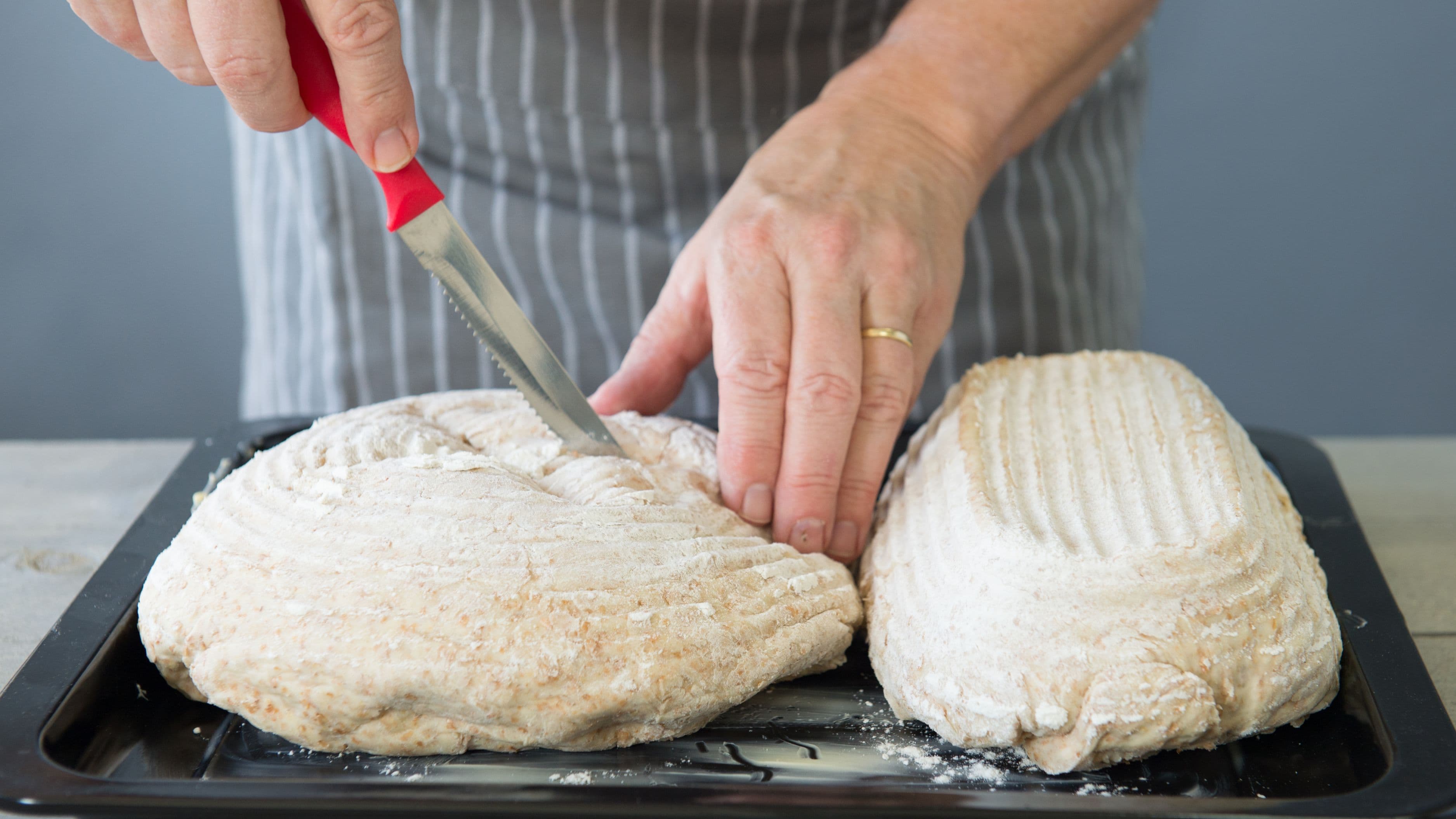
A standard kitchen knife can work in a pinch, but it typically produces a thicker, less clean cut compared to a proper blade, since most kitchen knives simply aren't thin or sharp enough at the edge to slice cleanly through the delicate surface tension of proofed dough without dragging or tearing it.
The Technique: Angle, Depth, and Motion
Hold your blade at roughly a 30 to 45-degree angle relative to the dough's surface rather than straight down. This angled approach, sometimes called "ear cutting," creates a distinctive flap of crust that lifts and curls during baking, which is part of what gives artisan bread its characteristic textured crust appearance rather than a flat, straight slash line.
Depth matters here too. Aim for a cut roughly a quarter to half an inch deep – shallow enough that you're not deflating the dough's structure, but deep enough to actually guide the expansion in the direction you want. Move the blade in one smooth, confident motion rather than sawing back and forth, since a hesitant, repeated motion tends to drag and tear the dough's surface rather than producing the clean edge you're aiming for.
Common Scoring Patterns and What They're For
A single, long diagonal slash down the center of a round loaf is one of the simplest and most forgiving patterns for beginners, since it requires only one confident cut and reliably gives the dough a clear expansion path. Multiple parallel diagonal cuts, commonly seen on baguettes, distribute the expansion across several points along the loaf's length rather than concentrating it in a single spot, which matters more for longer, narrower shapes.
More decorative patterns, like a cross-hatch or wheat-stalk design, are largely aesthetic once you've built confidence with the basic functional cuts, and they don't change the fundamental purpose of guiding expansion, just how that expansion visually manifests once baked.
What Happens If You Skip Scoring Entirely
Unscored dough doesn't fail to bake, but it will typically crack open somewhere on its own during oven spring, usually along the weakest point in the crust's surface tension. This uncontrolled crack is rarely as clean or attractive as a deliberate score, and it can occasionally cause more significant, uneven tearing that affects the loaf's final shape more than a controlled score would.
For enriched doughs with less overall crust tension, like a soft sandwich loaf, skipping scoring matters less since these doughs don't build the same dramatic pressure during baking that a lean, high-hydration artisan dough does.
Tips for Better Results
Make sure your blade is genuinely sharp, since a dull blade drags rather than slices, and dragging is the most common cause of uneven or torn scores rather than clean cuts. A light dusting of flour on the dough's surface just before scoring can also help the blade glide more smoothly without sticking.
If you're nervous about committing to a deep or elaborate score as a beginner, start with a single, moderate diagonal cut rather than an ambitious pattern. A simple, confident score consistently produces better results than a hesitant, elaborate one.
What to Avoid
Don't score too shallow out of caution, since a cut that barely breaks the surface won't guide expansion effectively, and the dough may still crack unpredictably elsewhere despite your intended score.
Avoid scoring dough that's over-proofed, meaning it's expanded too much before baking. Over-proofed dough has lost much of the surface tension that allows for a clean cut, and scoring it can cause it to deflate rather than expand properly in the oven.
Don't use a dull or thick blade and expect the same results as a proper lame or razor. The tool genuinely matters here, and a subpar blade is one of the most common reasons home bakers get frustrated with inconsistent scoring results.
FAQ
Do I need a special tool to score bread, or will a knife work? A sharp razor blade or dedicated bread lame produces noticeably cleaner results than a standard kitchen knife, since the thinness and sharpness of the blade matters significantly for a clean cut through proofed dough.
Why does my scored bread sometimes not open up during baking? This is often caused by scoring too shallow, using a dull blade that drags rather than cuts cleanly, or dough that's slightly under-proofed and lacks enough gas activity to expand strongly through the cut.
Does scoring affect the taste of the bread? No, scoring is purely a structural and visual technique. It doesn't add or change flavor, though the additional exposed crust surface from a well-scored loaf can develop slightly more caramelization and crust flavor during baking.
📚 Sources
King Arthur Baking Company – "How to Score Bread Dough" – https://www.kingarthurbaking.com/blog/2018/06/22/how-to-score-bread
The Bread Lab, Washington State University – "Bread Science Basics" – https://thebreadlab.wsu.edu/